
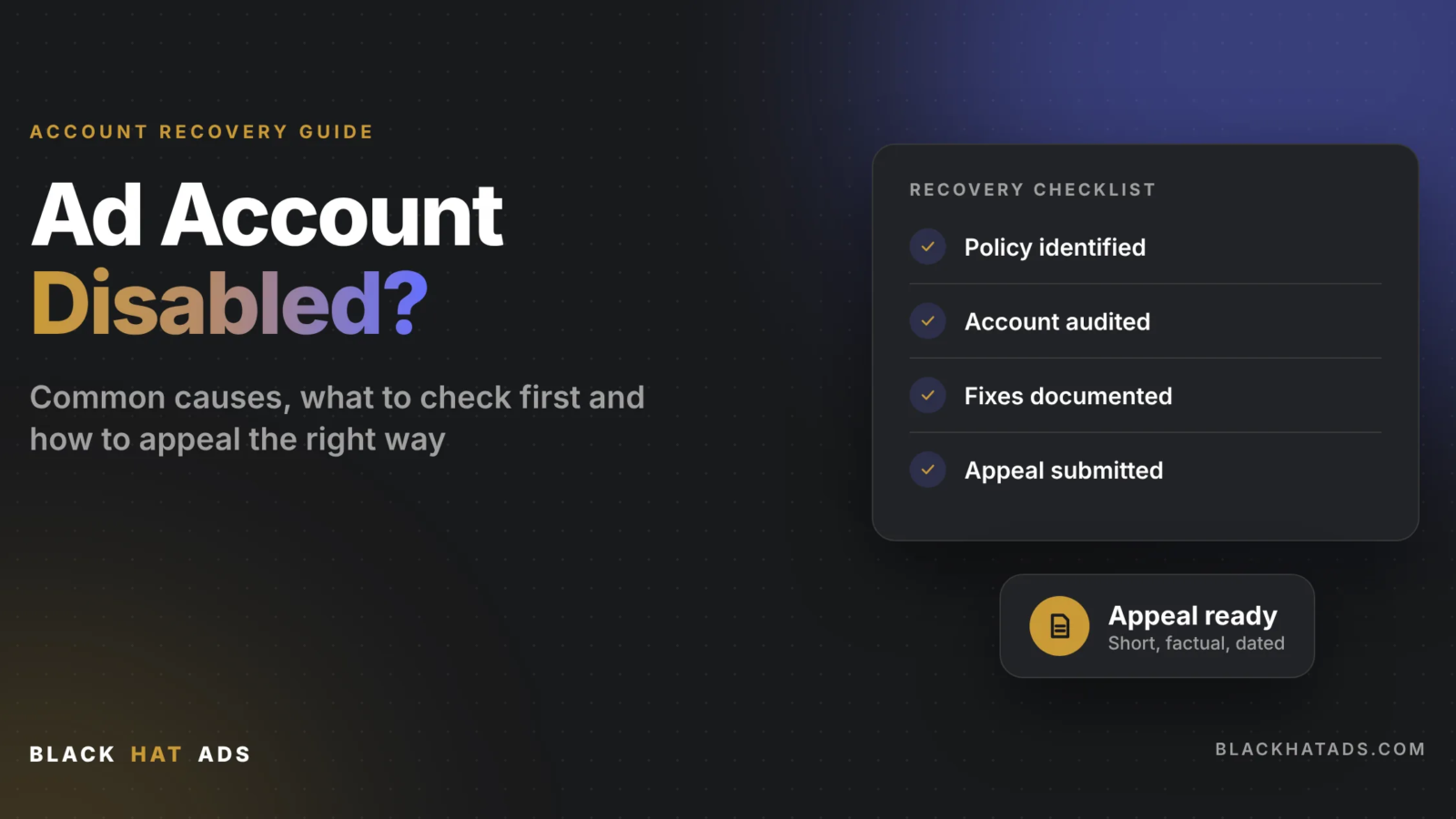
Why Was My Ad Account Disabled? Causes and Fixes
Monday morning, coffee in hand, you open Ads Manager and there it is in red. Ad account disabled. Every campaign frozen. Leads stop dead. And the notice is about as helpful as a fortune cookie.
We get a lot of these calls. Supplement brands, telehealth, finance, the categories that get looked at under a magnifying glass. Plenty of suspensions turn out to have a boring, fixable cause, and a fair few get reversed. What makes it worse, almost every time, is the panicked stuff people do in the first 48 hours.
What does “ad account disabled” actually mean?
Your account isn’t allowed to run ads right now because the platform thinks a rule got broken. Google calls it a suspension. Meta might say disabled, or restricted. Different words, same headache: nothing serves until the issue’s fixed or a review goes your way.
Don’t confuse it with a rejected ad. A rejected ad is a single piece of creative that didn’t pass. Annoying, but local. A disabled account is the platform saying it doesn’t trust you as an advertiser at the moment, which is a whole other level, and you can’t fix it by changing a headline and clicking resubmit.
Why would an account get disabled?
Going by the accounts we’ve dug into, it nearly always traces back to one of a handful of things. Lots of rejected ads, claims that went too far, a website that looks dodgy, card or login trouble, or behaviour the platform reads as dodging its review. Now and then the platform has simply got it wrong. That’s what appeals exist for.
Death by a thousand rejections
One rejected ad won’t sink anybody. Thirty of them inside a fortnight, all tripping the same rule? That adds up. The platforms keep score whether you do or not.
Promises that overreach
Cures. Guaranteed income. Dramatic before-and-after photos. Google’s misrepresentation rules and Meta’s Advertising Standards are both strict on this, and repeat offenders can go from the odd rejected ad straight to a full suspension.
A site that makes reviewers nervous
No company name anywhere. No phone number, no address. A page that talks about something completely different from the ad. Reviewers notice. The classic trigger we see is a one-page site with one product and an enormous Buy button.
Card and login weirdness
A failed payment, a card registered to a different name than the business, someone logging in from a country nobody on your team has ever visited. Any of those can put a hold on things. Good news, kind of: these are usually the quickest to sort. Update the card, verify your identity if asked, and quite often the hold just lifts.
Trying to slip past review
This is the one people don’t want to hear. Showing reviewers one page while real visitors see another, spinning up a new account after a ban, disguising what you sell. Platforms treat all of that as serious, and it regularly ends in a permanent ban that can drag linked accounts down with it.
What should you do first when your ad account is disabled?
Breathe, then read the notice properly. Note the exact policy it names. Check email for anything more detailed. Then look at every ad, keyword and landing page tied to that policy. Whatever you do, don’t open a new account or start resubmitting things until you understand what happened.
Open the actual policy page too, not the one-line summary in the notice. Read the whole thing. Then go through the account with that policy next to you: live ads, paused ads, extensions, images, every landing page. Anything that breaks the rule gets fixed or pulled. If the website’s the issue, fix the website.
While you’re in there, check billing and user access. Is the payment method right? Do you actually recognise every name on the account? You’d be amazed how often a freelancer from 2022 still has admin rights.
And keep notes as you go, with dates. A plain Google Doc is fine. You’ll need it for the next bit.
How do you appeal a disabled ad account?
Through the official route, briefly, with facts. Explain what you found, what you changed and when. Appeals tend to land when the problem genuinely is fixed or when you can show clearly that the platform misread something. Sending the same appeal four times in a row rarely moves anything.
On Google, the appeal a policy-related suspension page walks you through the steps. Meta usually lets you request a review straight from the notice in Business Suite, and their ad review guidelines explain what goes on behind the curtain.
A decent appeal doesn’t need to be long. A line or two on what you sell. Which policy got flagged and how you checked against it. The changes, with dates. Maybe one sentence on how you’ll stop it happening again. And leave the anger out, however justified it feels at 11pm. The reviewer reading it can’t do anything useful with it.

Can you actually get the account back?
Sometimes. Accounts disabled by mistake, or for issues that have honestly been fixed, often come back after review. Accounts banned for serious or repeated violations (anything that looks like dodging review especially) often don’t. We can’t promise reinstatement and neither can anyone else, whatever their sales page says. The platform decides.
If you want to see how this goes for other people, r/PPC has an endless supply of suspension threads. Worth a read. Just treat some of the advice in there with suspicion. If a fix sounds like a trick, it’s probably a trick, and tricks are how a suspension becomes a permanent one.
The less exciting truth is that prevention beats any appeal. Read your category’s policy before launching anything. Keep claims modest. Make it obvious who runs your site. When an ad gets rejected, fix the actual reason instead of tweaking a word and hoping. A quick account health check once a month catches most small problems before they grow teeth.
Rules also differ between platforms, sometimes a lot. An ad that sails through on Google can get flagged on Meta or Snapchat. Our guide to Snapchat ads approval covers Snap’s quirks, and the post on advertising supplements without rejections gets into health claims properly.
Conclusion
Key Takeaways
- A disabled account is a much bigger deal than a rejected ad.
- Piles of rejections, overblown claims, shady-looking sites and payment issues are the usual causes.
- Read the named policy and audit everything before you act.
- Appeal through the official route, short and factual, with dated fixes.
- Never open a fresh account or hide content to get around a ban.
It’s a horrible feeling, that red banner. But the way back is usually clearer than it looks on that first Monday. If you’d like a second pair of eyes on the account before you send your appeal, ask us for a free audit
Written by Black Hat Ads Team
Black Hat Ads specializes in paid advertising for restricted and hard-to-advertise industries, helping brands manage campaigns across major platforms while addressing ad approval, compliance, cloaking, and account-related challenges. The team focuses on performance-driven advertising strategies tailored to restricted niches.

Umar Hussain
11+ years of experience in Paid Ads, Cloaking Ads, Digital Marketing, eCommerce, Web Project Management, Media Buying, Funnels & Automations and Tech Startups Consultancy.
Comment