
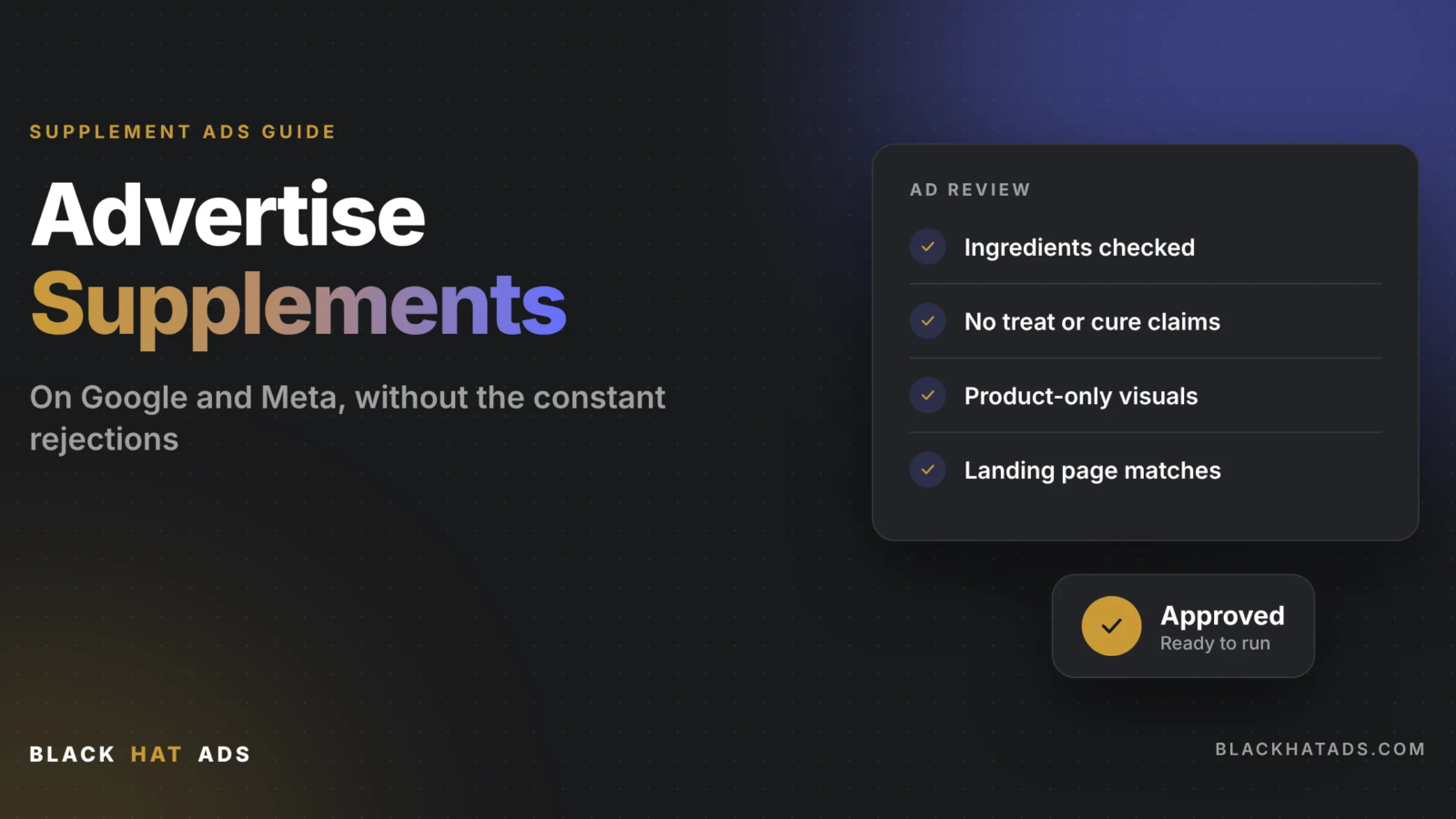
How to Advertise Supplements Without Ad Rejections
Ask any supplement founder about their first month of paid ads and you’ll usually get a slightly haunted look. Half the creative rejected. Reasons that seem to describe some other product entirely. A support chat that goes in circles.
So, can you advertise supplements on Google and Meta without living in that loop? Yes. Lots of brands do it every day. But this is one of the categories both platforms watch most closely, and it really helps to know what reviewers are looking for before you spend a penny. That’s what I want to walk through here, along with a few habits we’ve picked up from running supplement accounts.
Can you advertise supplements on Google and Meta?
You can, provided the product and the wording both stay inside each platform’s health rules. Some ingredients are completely off limits on Google. Health claims, weight loss angles and before-and-after imagery are restricted on both. Eligibility comes down to three questions really: what’s in it, what you’re saying, and where you’re selling.
Google keeps its rules in the healthcare and medicines policy, which is also where you’ll find the unapproved substances section. Meta’s equivalent is its health and wellness policy. Read both before you plan anything. After the first wave of rejections is a much more expensive time to discover them.
If somebody on your team is new to the category, Wikipedia’s dietary supplement page is a solid starting point, especially the bits on how rules vary between countries.
Why do supplement ads keep getting rejected?
In our experience it’s nearly always the ingredient list, the health claims, the visuals, or the landing page. Occasionally targeting. Each has its own fix, which is why it’s worth reading the rejection notice slowly instead of guessing and re-uploading.
What’s actually in the tub
Some ingredients can’t be advertised, full stop, even in countries where selling them is perfectly legal. Check every single one against the platform’s lists. Blends are where people get caught out. Someone checks the hero ingredient on the front of the label, misses the one tucked away in the proprietary blend, and the whole product gets flagged.
Claims
By far the biggest cause. Say a product treats, cures or prevents anything and you’re almost certainly getting bounced. Inflated promises about energy, immunity or weight usually go the same way. Google’s misrepresentation policy covers unrealistic claims, and Meta isn’t any softer.
Pictures, and talking at people
Before-and-after photos cause trouble everywhere, and on Meta especially. Same with close-ups of stomachs, thighs or skin. And copy that assumes something about the reader, like “Struggling with your weight?”, is a textbook rejection. Talk about the product. Leave the person scrolling out of it.
The page behind the ad
You can write the most careful ad in the world and still get rejected because it links to a page full of miracle claims. Reviewers check both. Every time.
So what can you say about your supplement?
Describe it. What’s in it, how much, what format, how to take it, what it tastes like if that matters. Third-party testing or certifications are worth mentioning, if you actually have them. Avoid anything about treating or preventing disease, and don’t promise particular results.
Some swaps we make constantly. “Melt belly fat in 14 days” becomes “A daily protein blend with 20g of protein per serving.” “Boost your immune system and never get sick” turns into “Vitamin C and zinc in one easy daily capsule.” And “Doctors hate this energy secret” (yes, it’s 2026 and we still see this one) ends up as “Caffeine-free energy blend made with B vitamins.”
They feel a bit flat on first read. I get it. But they get through review, and in the accounts we’ve run they often convert just as well, because specific beats vague more often than people expect.
If you want to test bolder angles, test them on things that aren’t health claims. Price, flavour, bundle deals, free shipping, how the product fits into someone’s morning. There’s loads of room to be creative there without going anywhere near a reviewer’s red pen. Save the detailed ingredient information for the product page, where you’ve got room to explain it carefully, keep the same honest tone and link out to proper sources.
What should the landing page look like?
Honest and boring, mostly. Who’s selling, what’s in it, how to use it, what it costs, how to get hold of you. The claims on the page should match the ad. Disclaimers where they’re needed. Shipping, returns and privacy pages one click away.
When we audit supplement sites we’re checking for a real company name and address somewhere visible, plus a full ingredient list and serving info right on the product page. Then pricing, especially subscription terms and how to cancel, which is a common sore spot. And a page that loads properly on a cheap phone over patchy mobile data.
Reviews are the sneaky one. If a customer review on your site says “this cured my anxiety”, that’s a health claim sitting on your website. It doesn’t matter that a customer wrote it rather than you. Moderate them.

Is Google or Meta easier for supplements?
Neither, honestly. They’re strict about different things. Google tends to care more about ingredients and product type. Meta cares more about imagery, personal attributes and targeting. Most brands we work with run both, with ads and landing pages written separately for each.
Trouble usually starts when someone copies one ad across every platform and crosses their fingers. Write for each one’s rules instead. Slower at the start, much less painful later. A basic spreadsheet helps a lot, one row per ad and a column per platform, so you can see at a glance what’s running where and what review said about it. Snapchat has its own personality as well, which we cover in our guide to Snapchat ads approval.
If rejections keep stacking up, stop resubmitting. Audit everything instead: ingredients, claims, visuals, targeting, page. A burst of rejections in a short window can put the whole account at risk. If you’re already past that point, our post on what to do when your ad account is disabled picks up from there. And no, nobody can guarantee approval. Anyone promising that is guessing with your money.
Conclusion
Key Takeaways
- You can advertise supplements on Google and Meta if products and claims follow their health rules.
- Ingredients, claims, visuals and landing pages cause most rejections.
- Describe the product. Skip treat, cure and prevent language.
- Keep the landing page transparent and consistent with the ad.
- Write separate ads for each platform rather than copying one everywhere.
Advertising supplements without the constant back-and-forth comes down to honest claims, clean creative and a site that backs it all up. Slower to get going, far easier to live with. If you’d like us to look over your ads and pages before launch, book a free audit
Written by Black Hat Ads Team
Black Hat Ads specializes in paid advertising for restricted and hard-to-advertise industries, helping brands manage campaigns across major platforms while addressing ad approval, compliance, cloaking, and account-related challenges. The team focuses on performance-driven advertising strategies tailored to restricted niches.

Umar Hussain
11+ years of experience in Paid Ads, Cloaking Ads, Digital Marketing, eCommerce, Web Project Management, Media Buying, Funnels & Automations and Tech Startups Consultancy.
Comment