
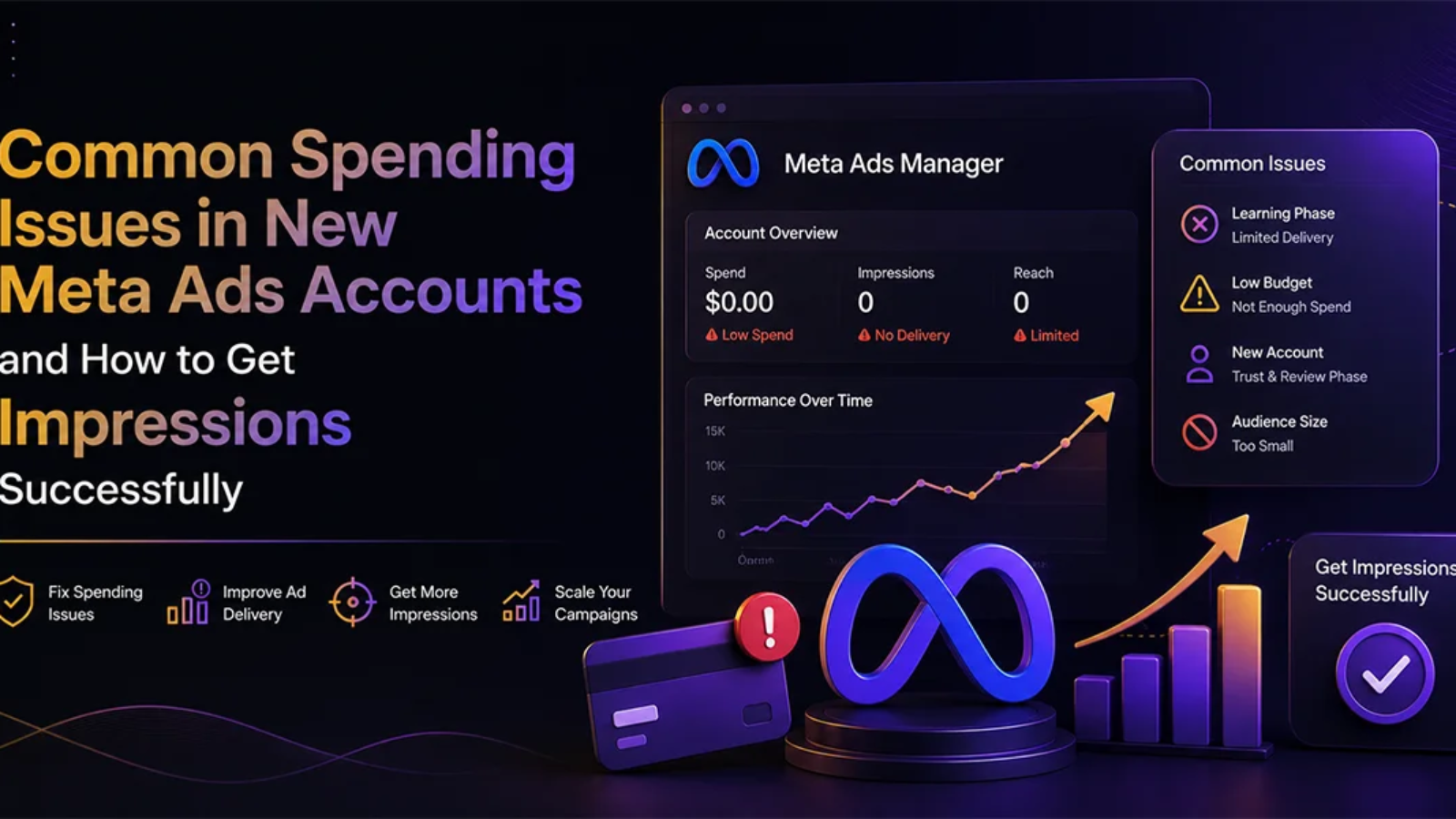
Introduction
Launching campaigns on a new Meta ads account often looks simple on the surface. You create a campaign, set your budget, publish the ads, and expect traffic to start flowing. In reality, many advertisers encounter a frustrating situation where ads remain active but do not spend, or worse, never leave the review phase.
After working with multiple new ad accounts across different industries, one pattern is clear: the issue is rarely just one thing. It is usually a combination of billing setup, account trust, ad structure, and platform signals. Understanding how Meta evaluates new accounts is the key to solving these problems quickly.
This guide breaks down the most common issues in new Meta ads accounts and provides practical, experience-based solutions to help you launch campaigns successfully.
Why New Meta Ads Accounts Struggle to Spend
If Meta attempts a card authorization hold that your bank does not approve, removing the current card and adding a new payment method can help restore normal ad spending.
Meta treats new ad accounts differently from established ones. A fresh account has no spending history, no trust score, and no performance data. Because of this, Meta’s system is more cautious when delivering ads. According to Meta Platforms official advertising documentation, new accounts go through an internal review and learning phase where delivery may be limited until sufficient performance and billing signals are established.
Industry research from WordStream also indicates that new campaigns can experience delayed delivery during the early learning phase, especially when insufficient optimization data is available. In fact, performance data across agencies shows that nearly 30 to 40 percent of new ad accounts experience delayed delivery or low initial spend during the first few days. This is not a glitch. It is part of Meta’s risk control system.
Billing and Card Issues: The Most Overlooked Problem
One of the most common reasons ads do not start is related to billing. Many advertisers assume that once a card is added, everything is set. That is not always the case. Meta often performs small authorization checks or test transactions to verify the payment method. If the card fails these checks, even silently, ad delivery may not begin.
As outlined in Meta Ads Help Center, payment failures or declined transactions can prevent ads from running even if campaigns appear active.
From experience, the following situations frequently cause problems:
- International cards not enabled for online transactions
- Banks blocking Meta-related charges
- Insufficient balance for authorization holds
- Mismatch between billing country and account location
The solution is simple but critical. Always check your billing section carefully. Confirm that your card is active for international and online payments. If possible, contact your bank and inform them about upcoming Meta transactions to avoid automatic blocks.
In many cases, switching to a different card or adding a backup payment method immediately resolves the issue.
Bank Transaction Delays and Payment Verification
Even when the card is valid, bank processing delays can impact ad delivery. Meta requires successful billing signals before it fully trusts a new account. If a payment attempt is pending or fails in the background, campaigns may remain active but not deliver impressions.
According to Google Ads Help, similar advertising platforms also rely heavily on successful billing events to initiate and sustain ad delivery, reinforcing that payment verification is a universal requirement across ad ecosystems.A practical approach is to manually trigger a small spend. You can do this by setting a low daily budget and monitoring whether Meta attempts to charge your card. If no transaction occurs within 24 hours, the issue is likely payment-related. Another effective method is to prepay or add funds if your account supports manual payments. This creates an immediate trust signal and often unlocks delivery faster.
Campaign Structure and Learning Phase Limitations
New advertisers often launch a single campaign with a single ad and expect results. However, Meta’s algorithm performs better when it has options to test and optimize. A common mistake is creating one heavy ad with high expectations. If that ad does not generate early engagement, the system has nothing to optimize, and delivery slows down.
Instead, it is more effective to launch multiple variations. Create lighter ads with simple creatives and clear messaging. These ads are easier for the algorithm to test and distribute. From experience, launching at least three to five ad variations significantly increases the chances of early traction. Once the system identifies a winning signal, spending begins to stabilize.
The Power of Duplicating Ads
One of the simplest yet most effective techniques in new accounts is ad duplication. If an ad is approved but not spending, duplicating it into the same or a new ad set can sometimes trigger delivery. This is because each duplicated ad enters the system as a new entity, giving it another chance to be evaluated.
This approach has worked consistently in situations where original ads remained stuck without clear reasons. It is not a workaround in the traditional sense. It simply leverages how Meta’s delivery system processes new entries.
Ad Weight and Creative Complexity
Another overlooked factor is ad weight. Heavy creatives, overly designed visuals, or complex messaging can slow down the review process and reduce early engagement. Meta prefers ads that are easy to understand and quick to process. Simple visuals, clear headlines, and direct messaging tend to perform better, especially in new accounts.Research from HubSpot highlights that simpler, clear messaging often outperforms heavily designed creatives in digital advertising, particularly in early campaign stages.
When launching a fresh account, focus on lighter ads. Avoid overloading creatives with too much information. The goal is to generate initial engagement signals, not to present everything at once. Once the account gains momentum, more advanced creatives can be introduced.
Checking the Billing Section Regularly
Many advertisers ignore the billing section after initial setup. This is a mistake. The billing area often contains hidden signals about why ads are not spending. Payment failures, pending charges, or account warnings may not always appear prominently in the campaign dashboard.
Make it a habit to review the billing section daily during the first week of running ads. Look for any unusual activity or failed transactions. Resolving these early prevents long delays in campaign performance.
Multiple Ads and Early Data Signals
Meta’s algorithm relies heavily on data. A new account has none, which makes the first few days critical. Running multiple ads increases the chances of generating early engagement. Even small interactions such as clicks or video views help the system understand your audience. According to benchmarks published by Statista, digital ad performance improves significantly when campaigns generate sufficient early engagement data, particularly in auction-based systems like Meta.
Experienced advertisers rarely rely on a single ad in a new account. Instead, they launch a small cluster of ads and allow the system to identify patterns. This approach not only improves delivery but also reduces the risk of campaigns getting stuck.
Patience and Controlled Scaling
One important factor that many overlook is patience. New accounts require time to stabilize. Trying to scale aggressively in the first few days often backfires. Sudden budget increases or major changes can reset the learning phase and slow down delivery again.
A better approach is controlled scaling. Start with a moderate budget, allow the system to gather data, and then increase spending gradually. Meta rewards consistency. Accounts that show stable behavior tend to gain trust faster.
Conclusion
Launching campaigns on a new Meta ads account is not just about creating ads. It is about understanding how the platform builds trust and processes new data. Most issues come down to a few core areas: billing setup, payment verification, ad structure, and early engagement
Written by Black Hat Ads Team
Black Hat Ads specializes in paid advertising for restricted and hard-to-advertise industries, helping brands manage campaigns across major platforms while addressing ad approval, compliance, cloaking, and account-related challenges. The team focuses on performance-driven advertising strategies tailored to restricted niches.